
- oceans.entp@gmail.com
- 0 Comments
Dr. Sunil Mhaske Urology
Best Urologist in Pimpri Chinchwad & Pune
MBBS, MS, MCh (Urology) — All India Rank 3. 15+ years treating kidney stones, prostate enlargement, bladder cancer & male infertility with laser, laparoscopic and robotic surgery. 24x7 emergency urology care.
Kidney Stone Size Chart: Which Sizes Pass Naturally and Which Need Treatment
If you have a Kidney Stone seen on scan, the first thing most will ask is how big is it, or will it pass? We hear people mention stones of 4mm, 8mm or 12mm but it might be difficult to understand what this means.
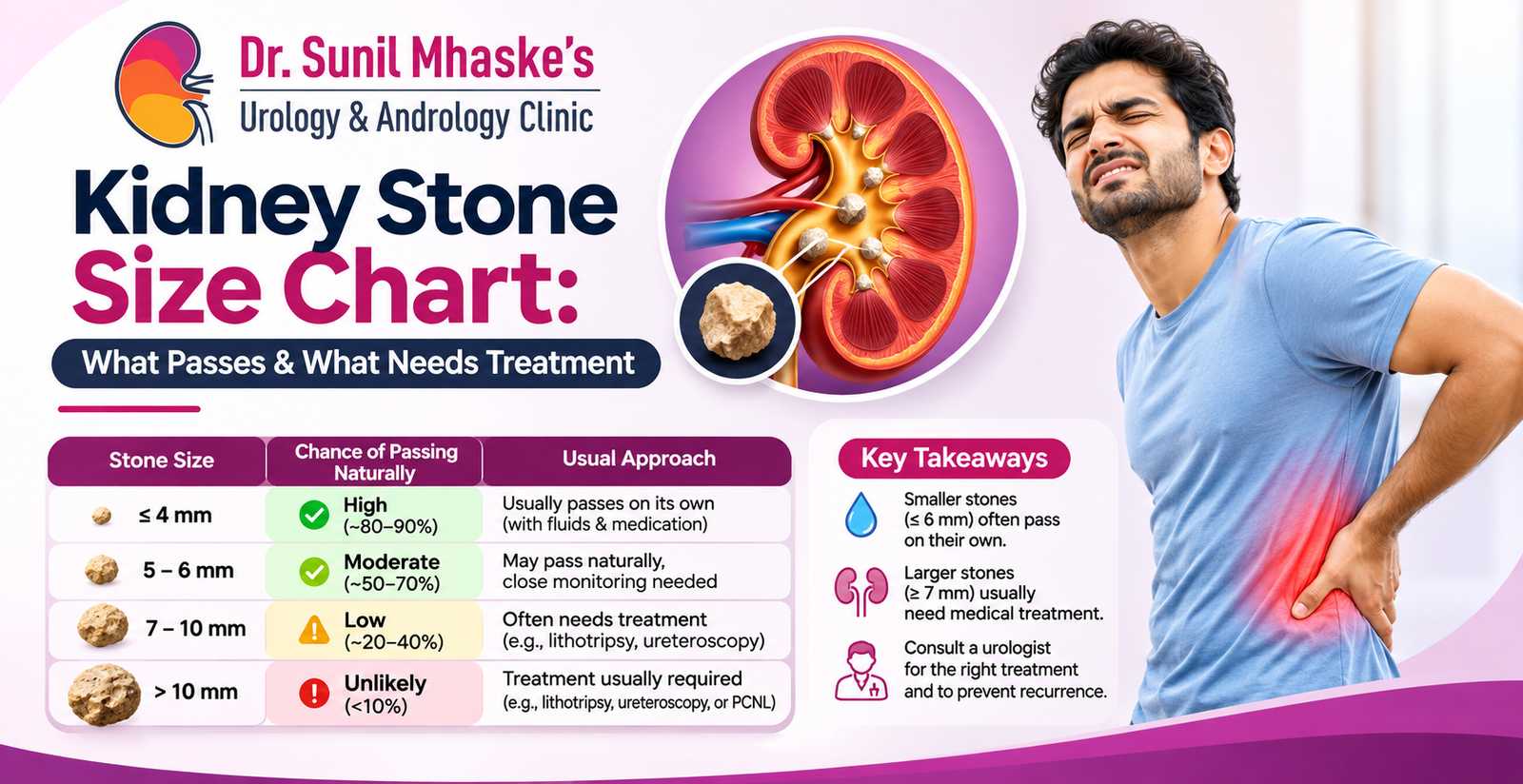
This Kidney Stone size chart will help explain what size stones are more likely to pass, and what are usually treated. It is a general guideline and only your urologist will be able to tell you what is best for you after examining you and looking at your reports.
Quick Answer: What Size Kidney Stone Will Pass Naturally?
Generally speaking, the smaller the stone the more likely it will pass. However, there are many factors involved including where the stone is, shape of the stone, symptoms you are experiencing and whether or not it is causing a blockage.
Below is a general guideline:
- Under 5 mm: Often many of these stones will Pass naturally with plenty of fluids, pain relief and regular monitoring.
- Between 5 mm–10 mm: Depending on the exact size and where the stone is, some may pass and some will not. If it is a larger stone in the ureter, this can cause issues. Medicines or a procedure may be considered.
- Over 10 mm: These stones are less likely to Pass Naturally and often require active treatment after being examined by a urologist.
This is a general guideline and will depend on the individual. A stone in this size category can behave differently depending on the individual. Your treating urologist will need to examine the stone.
How Is Kidney Stone Size Measured?
Kidney stones are measured in mm. Sometimes doctors will measure in cm so it is good to know:
- 10mm = 1cm
- 5mm = 0.5cm, around the size of a small pea.
- 10mm = 1cm, around the width of a small fingernail.
The two most common scans used are:
Ultrasound (USG)
This uses soundwaves to look for stones in the kidney and to see if the kidney is swollen due to a blockage. This is a safe option and available widely. It may not be as clear for small stones in the ureter.
CT Scan
This gives more detailed images to show the size, position and sometimes density of the stone. Often this scan is used if we need to know the exact details.
Sometimes the measurements can vary slightly. A stone can be 7mm on one scan and 8mm on another. This is because of how the scans work and measure the stones. This is normal.
Your doctor will also look at more than just the size. They will look at the scan report, symptoms and examination findings.
Kidney Stones Under 5 mm
Stones under 5mm are quite small and many will pass through the urinary system naturally. They often pass through the ureter, which is a small tube connecting the kidney and bladder.
You may experience:
- Side/back pain which comes and goes.
- Pain radiating to your lower abdomen or groin.
- A burning sensation or increased urge to go to the toilet.
- Blood in your urine.
- Nausea.
If the stone is still in the kidney it may cause no symptoms for a long time. If it is a small stone in the lower ureter (near to the bladder) it is generally more likely to pass.
If the stone is small and you are able to manage your pain and there is no blockage or infection, your doctor may suggest monitoring. This would involve taking medications, plenty of fluids and regular scans to see if it has passed.
However, even small stones can cause problems. If you are experiencing severe pain, a fever or struggling to pass urine, seek medical attention straight away.
5–10 mm Kidney Stones
This is a grey area. It will depend on the exact size and where the stone is. These stones can be more difficult to pass as they can get stuck in the narrow parts of the ureter.
5 mm Kidney Stone
This is the borderline between small and medium stones. Many can Pass Naturally. If it is already in the lower ureter it is more likely to pass. However, not all will pass.
If it isn’t moving, causing recurring pain or blocking your urine, treatment will be required.
8 mm Kidney Stone
This is less likely to pass. However, it is still possible. Where it is located will play a big part. If it is in the lower ureter it is more likely to pass. If it is in the upper ureter or kidney it is less likely. If it isn’t passing or causing blockage, pain or infection, a procedure may be considered.
Medications may be prescribed to help the stone pass and to manage pain. If your doctor feels this is suitable for you.
A procedure may be suggested if the stone is not passing, pain cannot be controlled, there is a blockage or infection.
It depends on the stone.
Kidney Stones Over 10 mm
Stones over 10mm (1cm) are less likely to pass naturally. The ureter is a narrow tube and stones can struggle to pass through.
They can cause:
- Blockage: Can cause a blockage to the urine.
- Infection: As the urine is not draining properly, it is more likely to become infected. This can be serious.
- Ongoing pain: Ongoing pain and recurring issues.
- Potential kidney damage: Potential damage to the kidney if the blockage is left for a long time.
Usually stones of this size will need to be looked at by a urologist. They will often require active treatment.
Treatment decisions depend on:
- Where the stone is.
- Size of the stone.
- Hardness of the stone.
- Kidney anatomy.
- Overall health.
Not all stones of 10mm will be treated the same. Your urologist will make a plan for you.
Where the Kidney Stone Is Located Matters
If the stone is in the kidney it may stay there for a long time, often causing no symptoms. Usually pain will occur once it starts to move into the ureter or is causing a blockage.
If the stone is in the ureter it is more likely to cause sudden severe pain. This is due to the ureter being a narrow tube and the stone can cause a blockage. The further down the ureter it is the more likely it will pass.
The lower pole of the kidney is the bottom part of the kidney. Stones here may not pass as easily due to the drainage of the kidney. This can affect what treatment your urologist will recommend.
This is why size alone won’t determine if treatment is required. Small stones can cause a blockage and may require treatment. However, larger stones that are sitting in the kidney may just require monitoring. Your doctor will take the size and location into consideration.
How Long Does It Take to Pass a Kidney Stone?
This can vary depending on the individual.
Factors affecting how long it will take:
- Size
- Location in the urinary system.
- Shape.
- Blockage.
- Your anatomy.
Some stones will pass quickly, within a few days or weeks. Some stones will take longer and some may not pass unless treated. No one can give you a definite time frame.
Regular follow up with a urologist is important. Regular scans will show if the stone is passing and if it is affecting your kidney. If it is not passing or complications arise, your treatment can be changed.
Medicines and Home Remedies That May Help
These can only be done under guidance from a doctor.
Pain Relief
Stones can cause severe pain. Your doctor can provide suitable pain relief.
Medical Expulsive Therapy
Alpha blockers are a type of medication that may help relax the muscle in the ureter. In some patients, your doctor may prescribe these to help the stone pass. Results can vary and will only be used if clinically indicated.
Drink Plenty of Water
Drinking enough water will help your urinary system. Your doctor can tell you how much to drink.
Don’t overdo it. If you are experiencing severe pain or the stone is causing a blockage, drinking large amounts of water can make your pain worse. Listen to your doctor.
Straining Urine
If advised by your doctor, straining your urine will help you to catch the stone. Knowing the type of stone will help your doctor to understand and plan for prevention.
Diet
This will depend on the type of stone you have. Generally speaking, staying well hydrated and not eating too much salt will help. Your doctor will advise you.
Not all kidney stones can be dissolved using home remedies or medications. Not all stones can be dissolved using just water, lemon juice or other home remedies. This can cause delays in getting the correct treatment. Avoid using unproven remedies.
Warning Signs: When Should You Go to Emergency?
If you are experiencing any symptoms of kidney stones and also have:
- A fever/chills.
- Severe or uncontrolled pain.
- Struggling to pass urine.
- Persistent vomiting or unable to keep fluids down.
- Signs of infection/blockage.
A Kidney Stone can become an urgent situation if it is causing an infection and blockage to your urine. Don’t leave it.
Kidney Stone Treatment Options by Size
There is no one treatment for all Kidney Stone sizes. Below are the main treatments:
Monitoring
If the stone is small, and you are able to manage your symptoms with no blockage or infection, your doctor may choose to monitor. This would involve regular scans.
Medical Expulsive Therapy
As mentioned above, medications can be given to help pass a suitable stone.
ESWL (Extracorporeal Shock Wave Lithotripsy)
Shockwaves are used from outside the body to break the stone into small pieces. These can then pass through the urine. This can be considered for some stones depending on the size, location and hardness.
Ureteroscopy (URS)
A thin telescope is passed through the urinary system to get to the stone in the ureter. It can then be broken up or removed. This is often used for stones in the ureter.
Retrograde Intrarenal Surgery (RIRS)
A very thin flexible telescope is passed through the urinary system to get to the kidney. The stone can then be treated, often using laser. No skin incision is made. This may be considered for some kidney stones.
Percutaneous Nephrolithotomy (PCNL)
A small incision is made in the back to directly access the kidney. This is usually considered for larger/complex kidney stones.
No treatment is set for a certain size stone. Your urologist will decide based on:
- Stone size and location.
- Hardness of the stone.
- Kidney anatomy.
- Symptoms.
- Overall health.
Frequently Asked Questions
Smaller stones are more likely to Pass Naturally. Stones under about 5mm are more likely to pass. Stones between 5–10mm may or may not pass depending on the exact size and location. Larger stones are less likely to pass without treatment. Your urologist will assess your stone.
Often yes, especially if it has already moved to the lower part of the ureter. However, not all stones of this size will pass. If it isn’t moving, causing recurring pain or causing a blockage, treatment may be required. Scans will be performed to help your doctor decide.
Both can be important. The size will tell us how easy it is to pass. The location will tell us if it is likely to get stuck somewhere or is causing a blockage. Your urologist will take this into consideration along with your symptoms and scan results.
This can vary. Some stones can pass within a few days/weeks. Some will take longer or may not pass without treatment. This depends on the size, location, shape and if there is a blockage. Regular follow up with a urologist is important.
There is no one size. Stones over about 10mm are less likely to pass and often require treatment. Smaller stones may also require a procedure if causing a blockage, infection, severe pain or not moving. It will depend on the overall picture.