
- Dr Sunil Mhaske
- 0 Comments
Dr. Sunil Mhaske Urology
Best Urologist in Pimpri Chinchwad & Pune
MBBS, MS, MCh (Urology) — All India Rank 3. 15+ years treating kidney stones, prostate enlargement, bladder cancer & male infertility with laser, laparoscopic and robotic surgery. 24x7 emergency urology care.
RIRS vs PCNL: Which Kidney Stone Surgery Is Right for You?
If your urologist advises you to have surgery for your kidney stones, you may have heard the terms RIRS and PCNL. These are both well-known methods of treatment for kidney stones.
This page aims to simplify the differences between the two procedures. It will explain how they work, who they can be appropriate for, recovery times and what the research shows. This is a general guide. Your urologist will advise you on what is appropriate for you based on your reports.
Quick Answer: RIRS vs PCNL
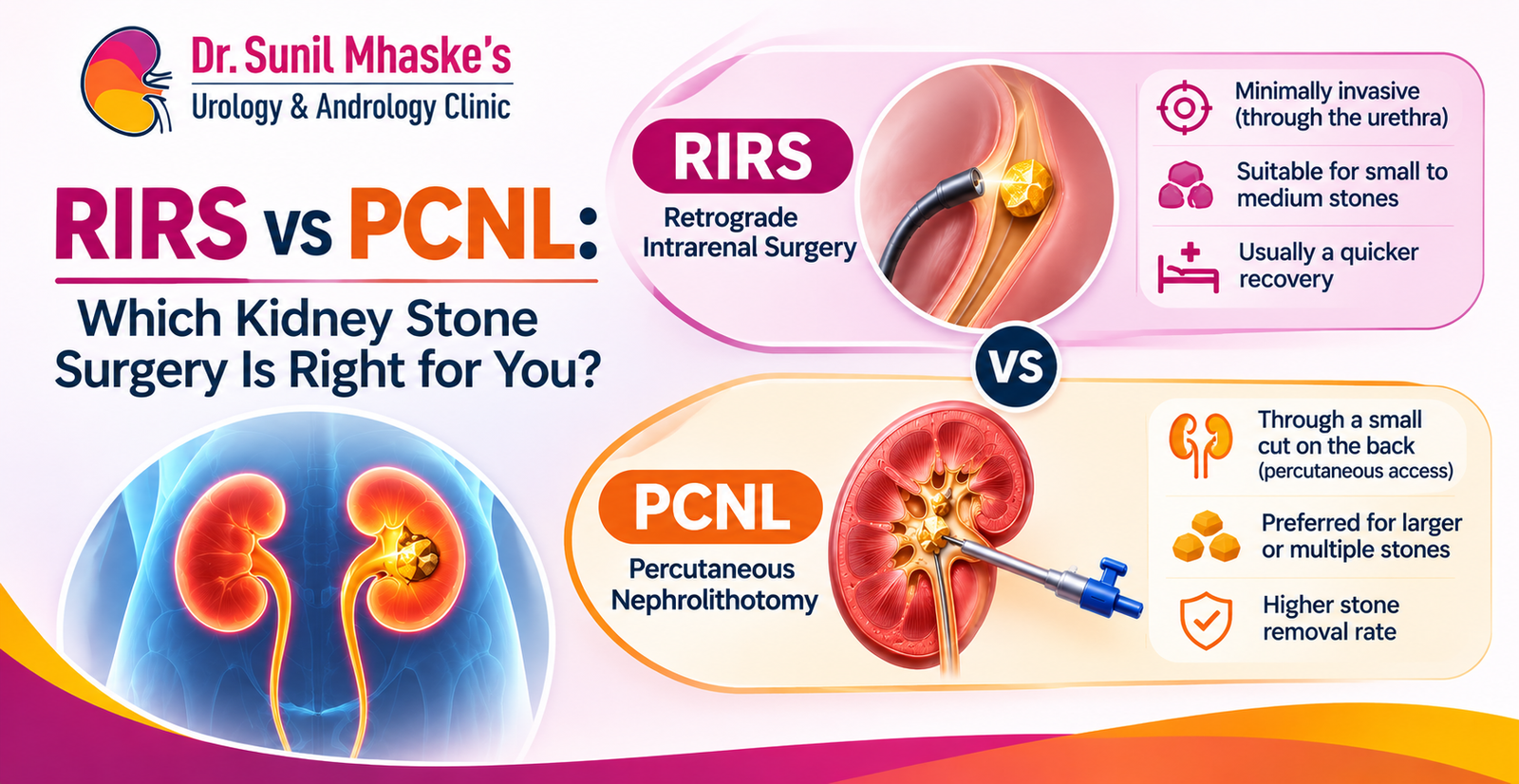
Both RIRS and PCNL are procedures used to treat stones in the kidney. The difference between the two is how the surgeon accesses the stone. RIRS uses the natural urinary tract to access the stone. PCNL uses a small cut on the back to reach the stone.
How the procedures work
- RIRS: A thin flexible telescope is inserted into the urinary tract and up to the kidney. A laser is used to break the stone into small pieces or dust.
- PCNL: A thin instrument is inserted through a small cut on the back to reach the kidney. The stone is broken into pieces and removed.
Appropriate stone size
- RIRS: Often suitable for smaller and selected medium-sized stones.
- PCNL: Often suitable for larger or complex stones.
These are general guidelines. The appropriate procedure depends on the individual case.
Invasiveness:
- RIRS: No skin incision. It is performed through the urinary tract.
- PCNL: Requires a small cut on the back.
Anaesthesia:
Both procedures are generally performed under anaesthesia. The type of anaesthesia used will depend on your health and what your doctor decides.
Length of hospital stay:
This depends on the procedure. PCNL often requires a longer hospital stay.
Stent or drainage tube:
- RIRS: Often a temporary DJ stent is placed to help keep the ureter open while healing.
- PCNL: May require a drainage tube or stent in selected cases.
Recovery:
RIRS generally has a simpler recovery because there is no external incision. PCNL involves recovery from the small cut on the back. Recovery varies from person to person.
Cost:
Costs can vary depending on the hospital, complexity of the stones, procedure and your individual requirements.
Neither procedure is automatically better for everyone. The choice depends on your stone size, position, kidney anatomy, health and what your urologist decides.
What Is RIRS (Laser Through the Urinary Tract)?
RIRS stands for Retrograde Intrarenal Surgery. Retrograde means that the instrument is inserted through the natural urinary tract to reach the kidneys. It is often referred to as laser kidney stone surgery.
How Is RIRS Performed?
- An anaesthetic will be used, as decided by your doctor.
- A very thin flexible telescope will be inserted into your urethra, bladder, ureter and kidney.
- The surgeon will locate the stone.
- A laser fibre will be inserted into the telescope and the stone will be broken down.
- Pieces of the stone may be removed using tiny instruments or may be left as small pieces to pass in your urine.
- A temporary DJ stent may be placed. This is a thin, soft tube that helps keep the ureter open and allows urine to flow.
As it is performed through the natural pathway in the body, it is referred to as a minimally invasive procedure.
When May RIRS Be Recommended?
Depending on stone size, position, hardness and anatomy, RIRS may be considered for selected kidney stones. Your urologist will decide based on your scans.
RIRS Recovery Time
Immediately after the procedure, you will be monitored while the anaesthetic wears off. You may feel some discomfort in the lower abdomen or when passing urine.
If a stent is in place, you may feel some burning sensations, urgency, frequent urination or blood in your urine. These are common and will generally only be for a short period of time.
Many people will be able to return to light activities after a few days. This will depend on how you are feeling and what your doctor advises.
If you have had a stent placed, it will need to be removed or changed. If left in for too long, it can cause issues. Please make sure you attend this appointment.
Recovery time will vary depending on the individual.
What Is PCNL (Keyhole Through the Back)?
PCNL stands for Percutaneous Nephrolithotomy. Percutaneous means “through the skin”. The surgeon will make a small cut on your back to directly access the kidney.
How Is PCNL Performed?
- An anaesthetic will be used, as decided by your doctor.
- A small cut will be made on your back and a small tube inserted into the kidney.
- A thin instrument will be inserted to reach the stone.
- The stone will be broken down and removed.
- A temporary drainage tube or stent may be placed in selected cases to help drain the kidney while healing.
As there is only a small incision, it is referred to as a minimally invasive surgery. However, unlike RIRS, it does involve an incision.
Why Is PCNL Often Considered for Larger or Complex Stones?
As the instrument is directly inserted into the kidney, the surgeon is able to deal with a higher stone burden and remove more pieces of stone in one session.
PCNL Recovery Time
After the procedure, you will generally be monitored in hospital. You may feel some soreness around the incision.
Recovery will depend on how complex the stones are, how many stones there are and your general health.
Your surgeon will advise you when you can return to work, exercise and travelling.
You will need to attend follow-up appointments to check your wound, see if you have any remaining stone fragments and to remove any tube or stent.
There is no guaranteed recovery time for everyone.
RIRS vs PCNL: Which One Is Appropriate for Your Stone Size and Location?
Your urologist will consider a number of factors before recommending a procedure.
Smaller stones and selected medium-sized stones
RIRS may be appropriate for smaller stones and selected medium-sized stones.
Larger stones
PCNL is commonly considered for larger stones.
Multiple or complex stones
These may require PCNL. Sometimes more than one procedure may be needed.
Position of the stone
The position of the stone can affect how easy it is to reach.
Lower pole kidney stones
The lower pole is the bottom of the kidney. It can be more difficult to remove the stone fragments, so this needs to be carefully considered.
Hardness of the stones
Hard stones may take longer to break down.
Kidney anatomy
The kidney and ureter anatomy can make one procedure easier than the other.
Medical history and general health
Your medical history, general health and any blood-thinning medications will also be considered.
Overall, there isn’t a definitive answer to which procedure is better. PCNL is commonly considered for larger or complex stones. RIRS may be appropriate for smaller and selected medium-sized stones. However, this is general guidance. Two people with the same stone size may require different treatment. The best procedure for you will depend on your reports and clinical condition.
Success Rates and the Need for Repeat Procedures
What is the stone-free rate?
Doctors often refer to the stone-free rate to show how many patients were stone-free, meaning they had no significant stone fragments, after treatment.
Factors affecting success
Stone size, number, position, hardness and kidney anatomy will affect success.
What does research say about RIRS vs PCNL?
A Cochrane review is a detailed summary of many clinical trials. A Cochrane review comparing PCNL and RIRS for kidney stones in adults was completed. It looked at 42 trials involving 4,571 randomised patients. The stones were generally medium to large in size, with an average size of between 10 mm and 39 mm.
The review found:
- More patients may be stone-free following PCNL, although the certainty of this evidence was low.
- Major complications were similar, with moderate certainty.
- PCNL may reduce the need for secondary procedures.
- The average hospital stay may increase by one day with PCNL.
Can a repeat procedure be required?
- Some patients may require more than one session of RIRS, particularly if they have larger or multiple stones.
- PCNL may be considered for larger or complex stones as it can often remove more stone.
- Small fragments of stone may need to be monitored or treated.
- Your urologist will advise you on what to expect.
Recovery Compared: What Happens After RIRS and PCNL?
Recovery will depend on the individual. Always follow your surgeon’s advice.
RIRS Recovery: Day by Day
Day 0:
You will be monitored after the procedure. You may feel some burning or discomfort in the urinary tract, particularly if you have a stent in place.
Day 1:
Many patients will feel fairly comfortable. If you are passing urine well and your pain is under control, you may be discharged.
Following days:
You will gradually increase your activity. You may still notice mild changes in your urine colour and discomfort from the stent.
Follow-up:
If you had a stent placed, it will be removed or changed. You may be advised to have follow-up imaging.
PCNL Recovery: Day by Day
Day 0:
You will be closely monitored for pain, bleeding and general wellbeing.
Day 1:
You will be checked for pain, urine output and colour. Any drainage tube will also be checked.
Following days:
It is important to look after your wound. You will gradually increase your activity. You will usually need to avoid heavy lifting for a period of time, as decided by your surgeon.
Follow-up:
You will be reviewed to check whether your stones have cleared, generally with imaging. Any drainage tube or stent will be removed when appropriate.
If you develop a fever, heavy bleeding, severe pain or difficulty passing urine, please contact your urologist.
Risks and Side Effects of RIRS and PCNL
All surgeries carry a risk. Complications are not guaranteed but will depend on your health, stone complexity and surgical factors.
Possible Risks of RIRS
- Blood in urine (temporarily).
- Burning or discomfort when passing urine.
- Urinary tract infection.
- Discomfort from a stent.
- Possible damage to the urinary tract.
- Need for a secondary procedure in selected cases.
Possible Risks of PCNL
- Bleeding.
- Infection.
- Soreness from the incision.
- Damage to surrounding organs or structures (rare).
- Leakage of urine or need for a temporary drainage tube.
- Further treatment if stones remain.
Before having any surgery, it is important to discuss the benefits, risks and alternatives with your urologist. Dr Mhaske’s clinic will explain these before any procedures.
What About ESWL and URS?
RIRS and PCNL aren’t the only options. Two other commonly used procedures are:
ESWL (Extracorporeal Shock Wave Lithotripsy)
- Shock waves are passed from outside the body to break the stone into small pieces.
- This may be appropriate for selected stones depending on their size, position and hardness.
- The stone fragments will pass out through the urine.
URS (Ureteroscopy)
- A thin telescope is passed into the urinary tract to reach the stone in the ureter.
- The stone may be broken up using a laser or removed using appropriate instruments.
- This is commonly considered for stones in the ureter.
Overall, ESWL is performed externally. URS is mainly used for stones in the ureter, while RIRS is used to treat stones in the kidney internally through the urinary tract. PCNL is used to treat stones in the kidney through the back. The right choice will depend on your stone and what your urologist decides.
Frequently Asked Questions
There isn’t a definitive answer. PCNL is commonly considered for larger or complex stones. RIRS may be appropriate for smaller and selected medium-sized stones. Research has shown that PCNL may remove more stone in one go. RIRS doesn’t require any incision in the back. Your urologist will decide what is best for you based on your scans.
Not necessarily. Both are well-known procedures and carry their own risks. A large Cochrane review found that major complications were likely to be similar. Safety will depend on your health, stone and surgeon’s experience.
Yes. A laser is passed through a thin flexible telescope to break up the stone into smaller pieces. As it is performed through the urinary tract, there is generally no incision in the skin.
This can vary. Many patients will be discharged shortly after the procedure. You will gradually return to your normal activities. However, you may experience some symptoms from the stent. Your doctor will advise you when you can return to work.
PCNL is often considered for larger stones as it provides direct access to the kidney. However, it won’t always be the only option. It will depend on the position, hardness, kidney anatomy and your general health.