- Dr Sunil Mhaske
- 0 Comments
Dr. Sunil Mhaske Urology
Best Urologist in Pimpri Chinchwad & Pune
MBBS, MS, MCh (Urology) — All India Rank 3. 15+ years treating kidney stones, prostate enlargement, bladder cancer & male infertility with laser, laparoscopic and robotic surgery. 24x7 emergency urology care.
Rezum Therapy for Enlarged Prostate: Procedure, Recovery & Cost in Pune
Common reasons men see a urologist include needing to urinate two or three times during the night, having a weak urinary stream or not feeling like they are emptying their bladder completely. Often, this is caused by an enlarged prostate.
Many men are happy to know there are options available if they aren’t keen to take medication forever or have major surgery. Rezum Therapy is one such option. This page gives you an overview of what it involves, who it is suitable for, how long the recovery takes, any side effects you may experience and how to find out the costs.
General information is given here, and your urologist will advise you on what is best for you.
Quick Answer: What Is Rezum Therapy and Who Is It Suitable For?
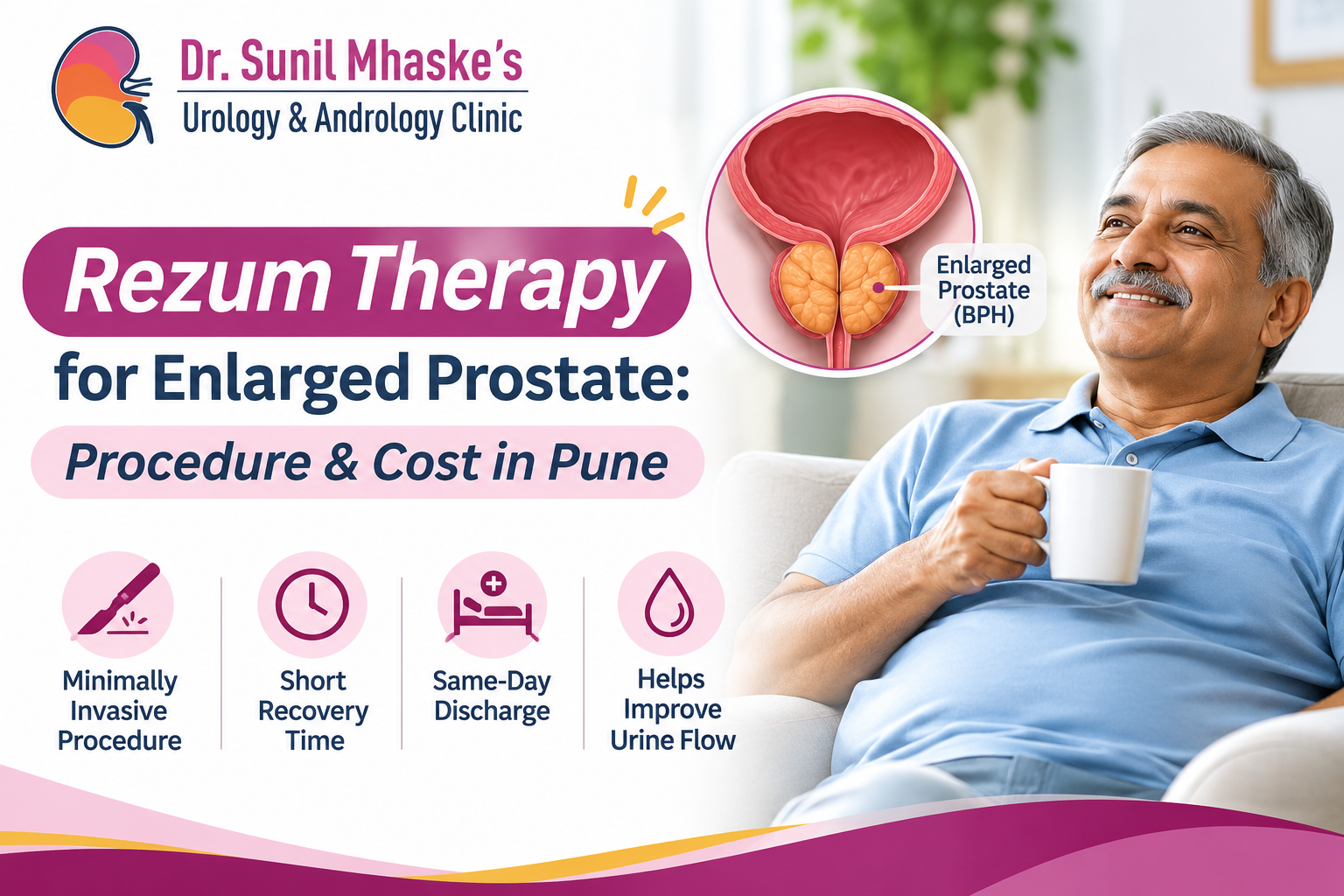
Rezum Therapy is a minimally invasive procedure that uses controlled amounts of steam (water vapour) to treat the extra prostate tissue causing problems with urination.
As the steam is introduced through your urethra (the tube you pass urine through), there is generally no incision made. The tissue is reabsorbed by the body over time. This can reduce some of the pressure on your urethra and improve your urinary stream.
Rezum Therapy may be considered for men suffering from troublesome urinary symptoms caused by an enlarged prostate, particularly if they haven’t seen enough improvement from medications or wish to discuss procedural options. It won’t be suitable for everyone.
Depending on your prostate size, symptoms, bladder function, medical history and your urologist’s advice, you will be advised on the most suitable treatment.
What Is BPH (Enlarged Prostate)? Common Symptoms
BPH stands for Benign Prostatic Hyperplasia. Benign means it isn’t cancerous, and hyperplasia means the prostate tissue has enlarged.
The prostate is a small gland situated below the bladder and surrounding the urethra. In many men, the prostate grows slowly over time. If it gets large enough, it can put pressure on the urethra, making it difficult to pass urine. Think of it like a garden hose being squeezed.
Please note that BPH isn’t prostate cancer and it doesn’t turn into cancer. However, it is possible to have both conditions. Your urologist may recommend investigations.
Common Symptoms of an Enlarged Prostate
- Passing urine frequently, particularly at night.
- Having a weak urinary stream.
- Difficulty starting to pass urine.
- Intermittent urine stream.
- Feeling that the bladder has not emptied completely.
- Sudden urge to pass urine.
- Dribbling after passing urine.
If these symptoms are causing problems, affecting your sleep or impacting your everyday life, it is a good idea to book a consultation. You don’t need to wait until your symptoms get worse.
If you are unable to pass any urine at all, please seek urgent medical attention. This is known as urinary retention.
How Rezum Water Vapour Therapy Works (Step by Step)
Below is a simple breakdown of what happens during a Rezum procedure.
Step-by-Step Rezum Procedure
- Your urologist will take your medical history and perform an examination.
- Your reports will be reviewed to ensure you are a suitable candidate for Rezum. This includes looking at your prostate size and relevant test results.
- A small instrument (a thin scope with a camera) is inserted into the urethra to reach your prostate.
- Controlled amounts of steam are introduced into the enlarged prostate tissue.
- The steam causes heat damage to the targeted tissue.
- Over the next few weeks, the tissue is naturally reabsorbed by the body.
- This can reduce pressure on your urethra and improve your urinary stream.
There is generally no incision made because the instrument is inserted through your natural urinary tract.
The type of anaesthetic used will depend on the patient and clinical team. This could range from local anaesthetic with or without sedation. Your doctor will explain what will be used.
Sometimes, a urinary catheter is inserted because the prostate can swell slightly after treatment.
How Long Does It Take to See Improvement?
Rezum doesn’t remove the prostate tissue straight away. The tissue is slowly reabsorbed by the body, so you may start to see improvements over the coming weeks.
Who Is a Good Candidate for Rezum Therapy (and Who Isn't)?
Rezum Therapy may be considered for selected men with enlarged prostate symptoms. However, it isn’t suitable for everyone.
Who May Be Suitable for Rezum?
- Men with troublesome urinary symptoms caused by BPH.
- Patients who haven’t seen enough improvement from medications.
- Men who wish to discuss procedural treatment options.
- Selected patients with suitable prostate size and anatomy.
Who May Not Be Suitable for Rezum?
- Patients with prostate size or shape outside the suitable range.
- Patients with specific urinary or prostate issues requiring a different treatment.
- Patients with an active urinary infection.
- Patients with bladder issues or other medical conditions that make a different treatment more suitable.
Your symptoms alone won’t determine whether Rezum is suitable for you. Your urologist may recommend investigations such as:
- Ultrasound: To assess prostate size.
- Urine tests: To check for urinary problems or infection.
- PSA blood test: If clinically indicated.
- Uroflowmetry: A test that measures your urine flow rate.
- Post-void residual: To measure how much urine remains in your bladder after passing urine.
- Cystoscopy: Or other investigations if needed.
Only your urologist can determine whether Rezum is suitable for you. The main research trial included men with a specific range of prostate sizes.
Rezum vs TURP vs iTIND vs Medicines
There are four different treatment options available for enlarged prostate. Each works differently and may be suitable for different patients.
Rezum Water Vapour Therapy
- Steam is introduced into the enlarged prostate tissue.
- No incision is made through the skin. The steam is introduced through the urethra.
- Improvements may take several weeks or longer.
- A temporary urinary catheter may be required.
TURP (Transurethral Resection of the Prostate)
- A scope with a cutting instrument is inserted into the urethra, and the prostate tissue blocking the urine flow is removed in pieces.
- It is a well-established and commonly used surgical treatment for BPH.
- It usually requires a hospital stay and a urinary catheter for a period of time.
- Recovery times and side effects vary. No guarantees can be given.
- Potential side effects include bleeding, urinary infection and changes in ejaculation. Your urologist will be able to give you detailed information.
iTIND (Temporary Implanted Nitinol Device)
- A small temporary device is inserted into the prostatic urethra to gently reshape the passage and improve your urinary stream.
- The device is removed after the required time.
- It works by a different mechanism from Rezum. It doesn’t use heat from steam.
- Suitability and availability depend on clinical assessment.
Medicines for Enlarged Prostate
- Some medications can help relax the muscles in your prostate and bladder neck, making it easier to pass urine.
- Some medications can also cause the prostate to shrink over time.
- They often require long-term use, and symptoms can return if you stop taking them.
- Side effects vary depending on the medication. Your doctor will be able to advise you on what is best for you.
There isn’t one best option for everyone. The decision to have Rezum, TURP, iTIND or medication will depend on your prostate size, anatomy, symptoms, bladder function, medical history and personal preferences.
You may have seen questions online such as “Rezum vs TURP” or “iTIND vs Rezum”. The honest answer is that there isn’t always one treatment that is better. Rezum and iTIND are both minimally invasive options that your urologist may discuss with you if you are seeking alternatives to traditional surgery.
Rezum Recovery Time: Recovery Timeline and Catheter Duration
Recovery times vary from patient to patient. Many patients can expect the following:
Immediately After the Procedure
- You may be monitored for a short period of time.
- You may feel some discomfort when passing urine, increased frequency or burning.
- A urinary catheter may be inserted.
First Few Days
- You may experience frequent or uncomfortable urination, burning or blood in your urine.
- If you have a urinary catheter in place, please follow the care instructions carefully.
- Ensure the area is kept clean. If your catheter becomes blocked, please contact your doctor.
Following Weeks
- You may experience some fluctuations in symptoms. This does not necessarily mean the treatment hasn’t worked.
- Improvements will generally happen gradually as the tissue is reabsorbed.
- Follow-up appointments will be important.
How Long Will I Have a Urinary Catheter?
This will vary depending on the patient. Factors that may influence how long you need a urinary catheter include:
- Prostate size.
- Whether you had urinary retention.
- Swelling.
- Bladder function.
- Your doctor’s assessment.
No guarantees can be given about a fixed catheter duration.
How Long Will I Be Off Work?
This will depend on how you are recovering and your doctor’s advice. Your urologist will inform you of any restrictions, such as avoiding heavy lifting.
Rezum Therapy Side Effects and Risks
Like any procedure, there can be side effects associated with Rezum. Most are temporary and will vary from patient to patient.
Potential Side Effects of Rezum Therapy
- Discomfort or burning when passing urine.
- Frequent urination.
- Urinary urgency.
- Blood in urine.
- Temporary difficulty passing urine.
- Temporary need for a urinary catheter.
- Further treatment may be required if symptoms don’t improve enough.
There are some risks involved with Rezum. Please contact your urologist if you experience:
- Fever or chills.
- Severe pain.
- Inability to pass urine.
- Worsening symptoms.
Before having the treatment, your doctor should explain the potential benefits, risks and alternatives so you can make an informed decision.
Rezum Therapy Cost in Pune
The cost of Rezum Therapy in Pune, and generally in India, will vary between patients.Factors that may affect the cost include:
- Prostate size and condition.
- Hospital or procedure costs.
- Anaesthesia costs.
- Investigations.
- Catheter and medication.
- Follow-up appointments.
- Personal requirements.
We haven’t listed a price because this can be misleading. The final cost can be confirmed after your consultation and assessment.
Frequently Asked Questions About Rezum Therapy
Find answers to common questions about Rezum Therapy, recovery, side effects and treatment options for an enlarged prostate.
01 What Is Rezum Therapy for an Enlarged Prostate?
Rezum Therapy is a minimally invasive treatment that uses controlled steam to treat the extra prostate tissue causing urinary problems. Steam is introduced through your urethra, so there is generally no incision made. The treated tissue is slowly reabsorbed by your body.
02 Is Rezum Better Than TURP?
Not always. They work differently and both have their benefits. TURP removes prostate tissue and is a well-established surgical option. Rezum is a minimally invasive treatment and may be suitable for some patients. Ultimately, it will depend on your prostate size, symptoms, health and personal preferences. Your urologist will be able to advise you.
03 How Long Does It Take to Recover After Rezum Therapy?
This will vary. Many men will be able to return to light activity fairly quickly. You may experience some fluctuations in your urinary symptoms for a few weeks. Improvements will generally happen gradually. Your doctor will advise you.
04 How Many Days Is a Catheter Needed After Rezum?
This will vary between patients. It will depend on your prostate size, swelling, bladder function and whether you had difficulty passing urine. Your urologist will decide when it is safe to remove it.
05 Does Rezum Therapy Have Side Effects?
Yes. Common side effects include discomfort or burning when passing urine, frequent urination, urinary urgency, blood in urine and temporary need for a urinary catheter. Most will settle over time. Please contact your doctor if you experience fever, severe pain or are unable to pass urine.
06 Is Rezum Therapy Painful?
Most patients will tolerate it well with the anaesthetic or sedation planned. Some discomfort is common after the procedure, such as burning or discomfort when passing urine. Your doctor will explain what to expect.
07 Can Rezum Therapy Treat a Very Large Prostate?
It may not be the best option for every patient with a very large prostate. The main clinical trial looked at men with prostates within a specific size range. Very large prostates may be better treated with a different procedure. Your urologist will measure your prostate and advise what is best.
08 Does Rezum Affect Sexual Function?
The source material refers to a five-year randomised trial in which no sexual dysfunction was reported in relation to the device or procedure, and no ongoing new erectile dysfunction was reported. Individual experiences can vary. Some men may notice temporary changes. If this is a concern, please discuss it with your urologist before treatment.
09 Can My Prostate Enlarge Again After Rezum?
BPH is a long-term condition, and your prostate can change with age. Rezum isn't a permanent cure. In the same five-year trial, 4.4% of patients required surgical retreatment. Real-world results can vary, and some men do require further treatment.
10 Is Rezum Better Than iTIND for BPH?
Not always. Rezum uses steam to treat your prostate tissue, whereas iTIND is a temporary device used to reshape the prostatic urethra. They work differently. The choice will depend on your prostate anatomy, symptoms and your urologist's assessment.