
- oceans.entp@gmail.com
- 0 Comments
Dr. Sunil Mhaske Urology
Best Urologist in Pimpri Chinchwad & Pune
MBBS, MS, MCh (Urology) — All India Rank 3. 15+ years treating kidney stones, prostate enlargement, bladder cancer & male infertility with laser, laparoscopic and robotic surgery. 24x7 emergency urology care.
Enlarged Prostate (BPH): Symptoms & Modern Treatment Without Major Surgery
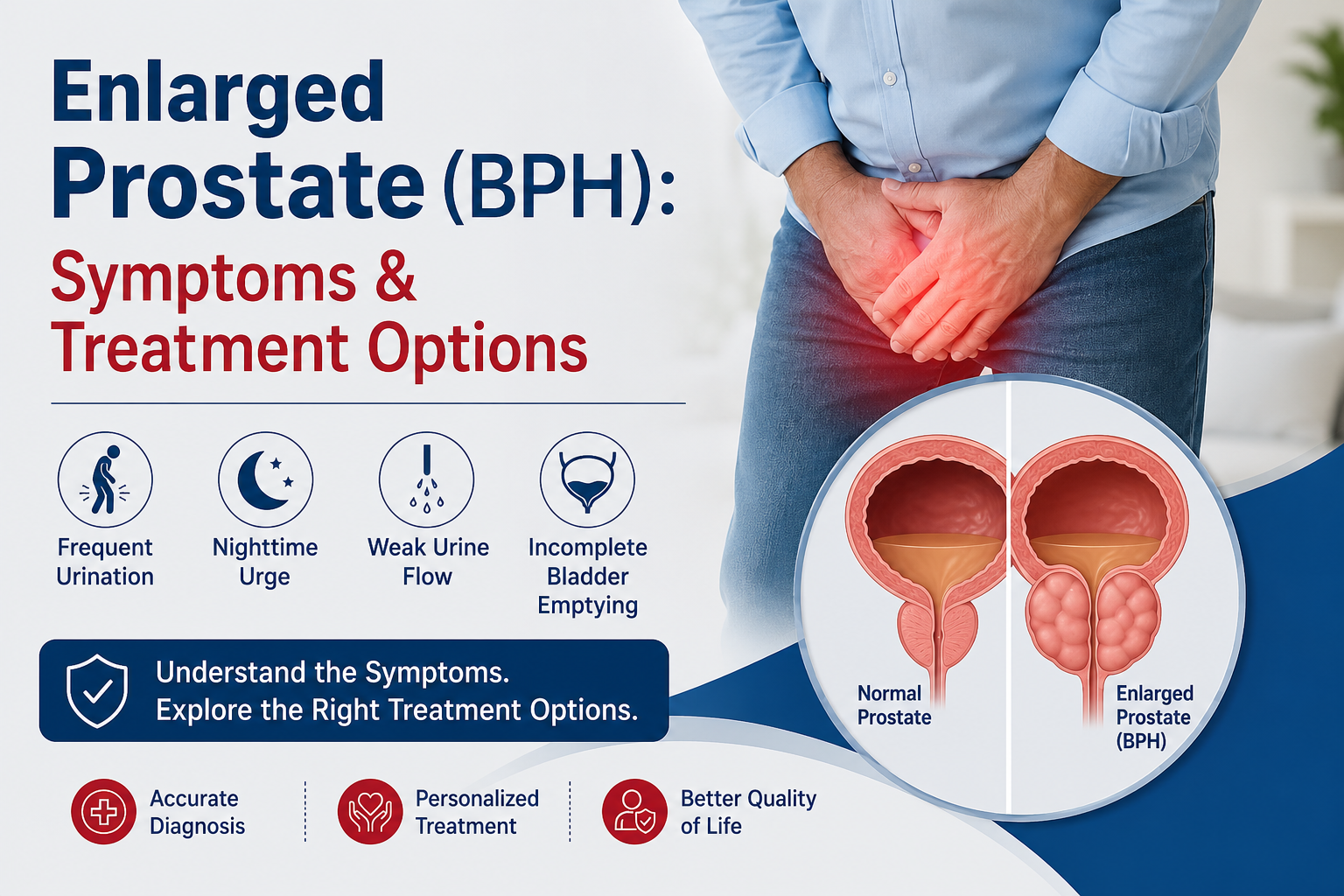
Getting up two or three times a night to pass urine, a weak stream, a feeling that the bladder never quite empties — many men accept these as an unavoidable part of getting older. As a urologist, I want you to know they’re not something you simply have to live with. They’re usually signs of an enlarged prostate, one of the most common conditions in men over 50 — and one of the most treatable, today often without any major surgery. In this guide, I’ll explain the symptoms, reassure you about what it is (and isn’t), and walk you through the modern treatment options.
What is an enlarged prostate (BPH)?
BPH stands for Benign Prostatic Hyperplasia — a non-cancerous enlargement of the prostate gland. The prostate sits just below the bladder and surrounds the urethra, the tube that carries urine out of the body. As men age, the prostate naturally grows, and when it enlarges enough, it squeezes the urethra, making it harder for urine to flow. It’s extremely common: symptoms usually begin around age 50, affect roughly half of men by 60, and up to 90% by 80.
Is it prostate cancer?
Let me address the worry that brings many men to my clinic. BPH is benign — it is not cancer, and it does not turn into cancer. However, because an enlarged prostate and prostate cancer can cause similar urinary symptoms, it’s important to be properly evaluated. A simple PSA blood test and examination help me confirm the diagnosis and rule out anything serious, giving you real peace of mind.
Symptoms of an enlarged prostate
The symptoms fall into two groups. Obstructive symptoms include a weak or slow urine stream, difficulty starting (hesitancy), straining, a stop-start (intermittent) flow, a feeling of incomplete emptying, and dribbling at the end. Storage symptoms include needing to urinate frequently, a sudden urgency, and — the classic early sign — waking repeatedly at night to urinate (nocturia).
When should you see a urologist?
Please consult a urologist if these symptoms are bothering you or affecting your sleep and daily life. And seek help urgently if you suddenly cannot pass urine at all (a painful condition called acute urinary retention), if you notice blood in your urine, or if you have repeated urinary infections — these need prompt attention.
What causes BPH, and who’s at risk?
The exact cause relates to hormonal changes with age, but the main risk factors are increasing age, a family history of prostate problems, obesity, diabetes, and heart disease. A sedentary lifestyle can contribute too. In short, it’s a natural part of ageing for most men — but that doesn’t mean the symptoms can’t be treated.
How is it diagnosed?
Diagnosis is straightforward and comfortable. I assess your symptoms (often using a simple scoring questionnaire), perform a brief prostate examination, and order a PSA blood test and urine test. I may also check your urine flow rate and use an ultrasound to measure the prostate size and see how well your bladder empties.
Treatment options for an enlarged prostate
The best part of treating BPH today is how many options we have — and how gentle they’ve become. Treatment is tailored to your symptoms and prostate size:
- Watchful waiting and lifestyle changes for mild cases — reducing evening fluids, caffeine, and alcohol, and bladder habits.
- Medications for mild to moderate symptoms — alpha-blockers to relax the prostate and improve flow quickly, and other medicines to shrink the prostate over time.
- Minimally invasive procedures for those who want to stop long-term medication or whose symptoms are troublesome.
- Surgery (such as TURP or laser HoLEP) for larger prostates or more severe cases.
Rezum and iTIND: treating BPH without major surgery
This is where modern urology has truly advanced, and where I can offer options many patients don’t realise exist. Rezum (Water Vapor Therapy) uses a few precisely delivered puffs of steam to gently shrink the excess prostate tissue; it’s a quick, minimally invasive procedure with a fast recovery. iTIND involves placing a small device in the urethra for a few days to reshape and widen the channel, after which it’s removed. The great advantage of both is that they relieve symptoms while preserving sexual function and avoiding the longer recovery of traditional surgery. For the right patient, these are excellent, gentle solutions.
Expert prostate care at Dr. Sunil Mhaske’s clinic
You don’t have to let an enlarged prostate disrupt your sleep or your life. With advanced options including Rezum, iTIND, laser and robotic treatment, and over 13 years of experience, I’ll help you find the gentlest effective solution — at my clinic in Pimpri Chinchwad, serving Pimple Saudagar, Pimpri and Pune.
📞 Book a consultation: +91 80874 93346 · Dr. Sunil Mhaske, Urologist — Pimpri Chinchwad, Pune
Frequently Asked Questions
- Is an enlarged prostate the same as prostate cancer?
No. BPH is a benign (non-cancerous) enlargement and does not turn into cancer. But because symptoms can overlap, a PSA test and examination are done to rule out cancer. - What are the first signs of an enlarged prostate?
Common early signs include waking at night to urinate, a weak stream, difficulty starting, urgency, and a feeling of incomplete emptying. - Can an enlarged prostate be treated without surgery?
Yes. Many men are managed with medication, and minimally invasive procedures like Rezum and iTIND relieve symptoms without major surgery, while preserving sexual function. - What is Rezum therapy?
Rezum uses water vapour (steam) to shrink excess prostate tissue. It’s a quick, minimally invasive procedure with a fast recovery and preserves sexual function. - Is frequent urination at night always due to the prostate?
Often it is, in men over 50, but not always. It can have other causes, so an evaluation is important to find the reason and treat it correctly. - When is surgery needed for BPH?
Surgery like TURP or laser HoLEP is considered for larger prostates, severe symptoms, or when medication and minimally invasive options aren’t enough. - At what age do prostate problems start?
Symptoms usually begin around age 50, affecting about half of men by 60 and up to 90% by 80.
Frequently Asked Questions
Stones under about 5 mm often pass on their own with plenty of water and medication. Larger stones, or those causing blockage or infection, usually need laser or shock-wave treatment.
Yes. Many small stones pass naturally, and larger ones can be treated with ESWL or laser (RIRS) without any large cuts. Only certain big stones need keyhole PCNL.
Modern treatments like RIRS and ESWL are minimally invasive and done under anaesthesia, so the procedures are not painful, and recovery is usually quick.
Dehydration is the biggest cause. A diet high in salt, protein, and oxalate-rich foods, along with our hot climate, also raises the risk.
Enough to keep your urine pale and clear throughout the day, and more in hot weather or with physical activity.